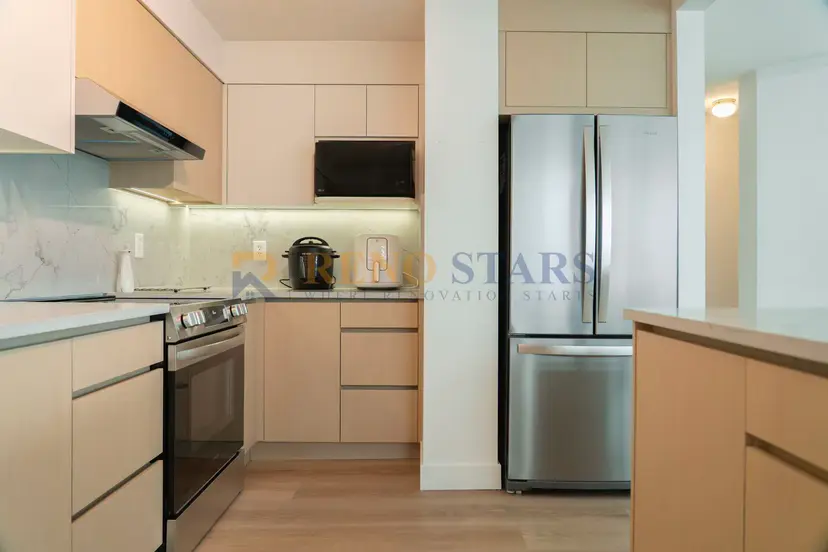
Quartz vs Granite Countertops for Vancouver Kitchens (2026 Guide)
Deciding between quartz vs granite countertops for your Vancouver kitchen? We break down cost per sq ft, durability, moisture resistance, maintenance, and resale value — with real data from local renovations.
Quartz vs Granite Countertops: Quick Comparison
Choosing between quartz vs granite countertops is one of the most common decisions Vancouver homeowners face during a kitchen renovation. Both materials look stunning, hold up well over time, and can significantly boost your home's resale value — but they perform differently depending on your lifestyle, budget, and the unique demands of Vancouver's climate.
This guide cuts through the marketing noise with real pricing data, performance comparisons, and insights from our completed kitchen renovation projects across Vancouver, Burnaby, Richmond, Coquitlam, and Surrey.
| Factor | Quartz | Granite |
|---|---|---|
| Cost (installed) | $60–$120/sq ft | $50–$100/sq ft |
| Durability | Very high (engineered) | High (natural stone) |
| Moisture resistance | Non-porous, excellent | Porous, needs sealing |
| Maintenance | Wipe clean, no sealing | Annual sealing required |
| Appearance | Consistent patterns | Unique natural veining |
| Heat resistance | Moderate (use trivets) | Excellent |
| Resale value | Very strong | Strong |
Cost Per Square Foot in Vancouver (2026)
Material costs have shifted in 2026 due to supply chain stabilization and increased demand from the Metro Vancouver housing market. Here's what you can realistically expect to pay for installed countertops:
Quartz Countertops
- Entry-level quartz: $60–$75/sq ft installed — solid colour slabs, thinner profile (2cm), builder-grade brands
- Mid-range quartz: $75–$95/sq ft installed — popular Calacatta and Carrara looks, 3cm thickness, Caesarstone or Silestone
- Premium quartz: $95–$120/sq ft installed — ultra-thick slabs, waterfall islands, exotic vein patterns, Dekton or Cambria
A typical 40 sq ft Vancouver kitchen countertop with quartz runs $2,400–$4,800 installed. Add a waterfall island (an extra 20–30 sq ft of material and more complex fabrication) and your total can reach $6,000–$8,000 for countertops alone.
Granite Countertops
- Entry-level granite: $50–$65/sq ft installed — common colours like Black Pearl or Uba Tuba, standard edge profiles
- Mid-range granite: $65–$80/sq ft installed — more unique veining patterns, Saint Cecilia or Alaska White
- Premium granite: $80–$100/sq ft installed — exotic slabs, book-matched patterns, rare imports from Brazil or India
For the same 40 sq ft kitchen, granite typically runs $2,000–$4,000 installed — making it slightly more affordable at the entry level, though premium granite and premium quartz can reach similar price points.
What drives costs up: complex cutouts (undermount sinks, cooktops), waterfall edges, full-height backsplashes, and removal of existing countertops add $200–$800 to any job.
Durability: Which Holds Up Better?
Quartz
Quartz is an engineered stone made of roughly 90–94% ground natural quartz crystals bound with polymer resins. This manufacturing process produces a highly consistent, impact-resistant surface that resists chips and cracks better than natural stone. You won't find weak veining lines or natural fissures that can become stress points over time.
The main durability caveat for quartz: it's less heat resistant than granite. The resin binders can discolour or crack if exposed to direct heat above 150°C (300°F). Always use trivets — never put a hot pan directly on quartz.
Granite
Granite is one of the hardest natural stones on earth, scoring 6–7 on the Mohs scale. It handles heat beautifully — you can set a hot cast iron skillet directly on it without damage. However, granite can chip at edges and corners if struck sharply, and natural fissures (hairline fractures already present in the stone) can sometimes propagate under stress.
Quality matters enormously with granite. High-grade slabs with tight grain structure outperform cheap imports that may have pre-existing micro-fractures. Always inspect slabs in person before purchase.
Moisture Resistance in Vancouver's Climate
Vancouver's notoriously damp climate makes moisture resistance a genuine concern — not just for bathrooms, but for kitchens too. Humidity, steam from cooking, and the simple reality of wet countertops every day mean your material choice matters.
Quartz: The Winner for Wet Environments
Quartz is non-porous by nature of its manufacturing. Liquids, bacteria, and mould cannot penetrate the surface. There's no need to seal it, and spills of coffee, red wine, or acidic citrus juice won't stain if wiped up within a reasonable time. For Vancouver homeowners who cook frequently, quartz's non-porous surface is a significant practical advantage.
Granite: Manageable with Proper Sealing
Natural granite is slightly porous — it has microscopic pores that can absorb liquids if left unsealed or if the sealant wears off. In Vancouver's kitchen environment (cooking steam, wet produce, coffee, oil), an unsealed or under-sealed granite countertop can stain or harbour bacteria over time.
The solution is regular sealing: most granite countertops need resealing every 12–18 months. This is a 30-minute DIY task with off-the-shelf granite sealer. If you stay on top of it, granite performs very well in the kitchen. If you're the type to skip maintenance, quartz is the safer choice.
Maintenance Requirements
Quartz
- Daily cleaning: warm soapy water and a soft cloth — that's it
- No sealing, ever
- Avoid harsh chemicals (bleach, oven cleaner) which can dull the surface over time
- Avoid prolonged UV exposure — some quartz colours can fade in direct sunlight near windows
Granite
- Daily cleaning: mild dish soap and warm water — avoid acidic cleaners like vinegar
- Seal annually with a penetrating granite sealer ($20–$40 at any hardware store)
- Blot spills immediately — especially red wine, coffee, and oils
- Re-polish edges if chips occur (professional repair, typically $150–$300)
Appearance and Style
Quartz: Consistency and Variety
Because quartz is manufactured, you get consistent colour and pattern from slab to slab — ideal when you need multiple slabs for a large kitchen island or L-shaped countertop and want them to match perfectly. The colour range is enormous: pure whites, warm creams, dramatic blacks, concrete greys, and increasingly convincing Calacatta marble looks.
The trade-off is that quartz can look "too perfect" to some eyes. The patterns are consistent across the slab rather than flowing naturally, which experienced stone enthusiasts sometimes find less interesting than natural granite.
Granite: Unique Natural Beauty
No two granite slabs are identical. The natural veining, crystal patterns, and colour variations mean your countertop is genuinely one-of-a-kind. Many Vancouver homeowners specifically choose granite for its organic character — the way light plays across the natural mineral crystals and veins creates a warmth and depth that engineered stone can't fully replicate.
The challenge: matching multiple slabs is harder. If your kitchen requires two or three slabs, getting consistent patterning requires careful slab selection at the stone yard.
Resale Value in the Vancouver Market
Real estate data from Metro Vancouver consistently shows that both quartz and granite add meaningful resale value compared to laminate or tile countertops. In the $800K–$1.5M condo and townhouse segment that makes up much of Vancouver's resale market, quality stone countertops are expected by buyers.
Quartz currently has a slight edge in resale: Vancouver buyers at open houses consistently rate quartz as "move-in ready" without concern about maintenance. Realtors frequently mention that quartz kitchens photograph better for listings (consistent colour, no natural variation that can look like staining in photos).
Granite holds its own in the luxury segment: For homes above $1.5M, unique granite with dramatic natural veining can actually command a premium, as it signals distinctive high-end choices rather than builder-grade selections.
In our experience from projects in Burnaby, Richmond, and Coquitlam, homeowners who renovate to sell see roughly a 1.5–2x return on countertop investment in the current market, regardless of which material they choose — provided the installation quality is high.
Real Project Data: What Vancouver Homeowners Actually Choose
Looking at our completed kitchen renovations across Metro Vancouver, quartz dominates for mid-range projects ($20,000–$35,000 total kitchen budget). Granite tends to appear in either budget-conscious renovations where homeowners find excellent slabs on sale, or in higher-end projects where clients specifically want natural stone character.
Our bathroom renovation cost guides follow a similar pattern — engineered surfaces for value, natural stone for prestige. The key insight: your countertop material should complement the overall renovation vision, not be chosen in isolation.
For example, our Coquitlam condo kitchen renovation featured custom quartz countertops specifically because the client was preparing the home for sale — the consistent, clean look photographs beautifully and appeals to the widest range of buyers. Our Burnaby custom kitchen with wood-vein cabinets used quartz with subtle veining to complement the cabinetry without competing with it.
Which Should You Choose?
Choose Quartz If:
- You want zero-maintenance countertops (no sealing, no special cleaners)
- You cook frequently and want spill-resistance without stress
- You're renovating to sell and want maximum buyer appeal
- You need multiple slabs to match perfectly across a large kitchen
- You prefer a modern, clean aesthetic with consistent patterning
- You have young children (bacteria-resistant, easy to sanitize)
Choose Granite If:
- You want a truly unique countertop — no two slabs identical
- You love to cook and need heat resistance (can place hot pans directly)
- You're comfortable with annual sealing maintenance
- You prefer the warmth and character of natural stone
- Your kitchen design calls for organic, natural materials throughout
- You find an exceptional slab at a competitive price
The Bottom Line
For most Vancouver homeowners, quartz is the safer, more practical choice. It's competitively priced, requires no maintenance, performs brilliantly in Vancouver's damp climate, and has strong buyer appeal. If you want the organic beauty and heat resistance of natural stone — and you'll commit to annual sealing — granite is an equally excellent choice that has stood the test of time.
The best decision is always one made in the context of your full kitchen renovation. Our team helps clients think through material choices as part of the complete design process — countertops, cabinets, flooring, and fixtures should work together as a cohesive system.
See our verified five-star reviews from Metro Vancouver homeowners.
About Reno Stars — Vancouver-based renovation company serving Metro Vancouver since 2019.
View our renovation project portfolio →
Ready to explore your countertop options? Our kitchen renovation services team is happy to walk you through current material availability, pricing, and what works best for your space. Get a free renovation estimate and we'll bring samples to your home so you can see how different materials look in your actual lighting conditions.
Not sure about the overall budget for your kitchen project? Explore our full collection of kitchen and bathroom renovation guides for Vancouver-specific pricing and planning advice.
Metro Vancouver homeowners increasingly include a heat pump HVAC upgrade in their renovation plans — these systems provide efficient heating and cooling year-round, and qualify for BC Hydro and CleanBC rebate programs.
When renovation projects add new appliances, EV charging stations, or smart home systems, a critical load panel upgrade is often needed to safely handle the increased electrical load.
For homeowners planning long-term or accommodating family members with mobility needs, accessible bathroom renovations — including grab bars, curbless showers, and slip-resistant flooring — are a smart addition to any major renovation project.
If your Metro Vancouver home was built before 1995, it may have poly-B pipes. Our poly-B pipe replacement service addresses this common issue before it leads to costly water damage — something worth considering during any major renovation.
If you live in a strata property (condo or townhouse), review BC's strata renovation rules before starting work — many projects require strata council approval and must follow specific noise, hour, and contractor requirements.
Frequently Asked Questions
Is quartz or granite better for Vancouver kitchens?
Both are excellent choices, but for Metro Vancouver's high-humidity coastal climate, quartz has practical advantages. Quartz is non-porous (no sealing required), highly stain-resistant, and uniform in pattern — popular in Vancouver's contemporary and West Coast modern kitchens. Granite is natural stone with unique veining, requires annual sealing, and is slightly more heat-resistant at the surface. In Vancouver's 2026 market, quartz outsells granite approximately 3:1 for kitchen countertops. For bathrooms, both perform similarly; quartz is typically easier to maintain.
How much do quartz countertops cost in Vancouver in 2026?
Quartz countertop installation in Metro Vancouver costs $85–$200+ per sq ft installed, depending on slab thickness (2cm vs. 3cm), brand (entry-level vs. Silestone/Caesarstone), and edge profile complexity. A typical 25 sq ft kitchen countertop (standard galley or L-shape) costs $2,125–$5,000 installed. Island countertops add $800–$2,500. Premium brands and custom colours run higher. Undermount sink cutout adds $200–$400. Reno Stars sources from multiple local suppliers and includes standard installation and removal of existing counters in our quotes.
How much do granite countertops cost in Vancouver in 2026?
Granite countertop installation in Metro Vancouver runs $75–$175 per sq ft installed for standard imported granite; premium slabs (Brazilian, Italian, or rare colours) run $150–$280+/sq ft. A 25 sq ft kitchen costs $1,875–$4,375 for standard granite. Natural variation means pricing depends heavily on the specific slab — you choose at the slab yard. Sealing is required annually ($50–$150 DIY or included in some contractor warranties). Reno Stars visits slab yards with clients on larger projects to select the exact slab.
How long does quartz or granite countertop installation take?
Countertop replacement is a 2-step process: (1) template visit after cabinets are in (1 hour, 1 day appointment); (2) fabrication and installation, typically 7–14 days after template. Installation day: old counters out in the morning, new counters in by afternoon (3–6 hours for a standard kitchen). You'll be without a kitchen sink for 1–2 days while caulk cures. Backsplash tile installation follows countertop install by 24–48 hours. In Reno Stars kitchen projects, countertop templating is scheduled as soon as upper cabinets are hung — no wasted time.
Can quartz or granite crack or chip in Vancouver homes?
Quartz is more chip-resistant than granite at edges (engineered composite vs. natural stone). Neither is indestructible — both can crack from thermal shock (e.g., setting a pot directly from the stove), sharp impact at edges, or improper support during transport. Granite is more porous and can absorb stains (red wine, oil) if not sealed. In practice, both materials last 20–30+ years with normal care. Reno Stars installs with full support brackets on overhangs and uses silicone joins at sink cutouts to minimize stress points. Our 3-year workmanship warranty covers installation defects.
How do I maintain quartz vs granite countertops in a Vancouver kitchen?
Maintenance comparison for Vancouver kitchens: Quartz countertops are non-porous and require no sealing — clean with soap and water or a mild non-abrasive cleaner. Avoid prolonged exposure to direct UV (can fade) and don't place hot pots directly on the surface. Granite countertops are porous and require sealing every 1–3 years (test by applying water: if it beads, no sealing needed; if it absorbs, seal it). A professional granite sealing application costs $150–$300. Both materials handle Vancouver's climate well — the wet weather doesn't affect sealed stone surfaces indoors. For the maintenance-averse homeowner, quartz is the simpler long-term choice.
Browse our renovation design gallery for real project photos.
Also see: Vancouver Kitchen Renovation | Kitchen Cabinet Colours Vancouver | Bathroom Renovation Vancouver | Whole-House Renovation Vancouver | Basement Renovation Vancouver | How to Choose a Contractor | BC Renovation Permits Guide | Renovation Timeline Guide | Vancouver Renovation Cost Guide 2026 | How to Finance Your Vancouver Renovation (HELOC Guide) | Renovation Financing Options
See Also — Renovation Cost Guides
- Kitchen Renovation Cost Vancouver — average $15K–$80K in Metro Vancouver
- Basement Renovation Cost Vancouver — average $20K–$80K
- Whole House Renovation Cost Vancouver — average $50K–$300K+
- Cabinet Refinishing Cost Vancouver | Cabinet Refinishing Vancouver — from $4K for refinishing
Reno Stars
Professional renovation company serving Metro Vancouver with 20+ years of experience, $5M CGL insurance, WCB coverage, and up to 3-year warranty.