Rental Property Renovation Vancouver: ROI Calculator for Landlords (2026)
Which renovations actually pay off for Vancouver landlords? ROI table, basement suite conversion numbers, BC tenancy law rules, and a real turnover renovation calculation showing 3.4-year payback.
Rental Property Renovation Vancouver: ROI Calculator for Landlords (2026)
Vancouver landlords are sitting on one of the biggest untapped levers for rental income: strategic renovation. The right upgrades can increase monthly rent by $400–$1,200 while reducing vacancy, attracting better tenants, and qualifying for higher refinancing valuations. Here's exactly which renovations deliver the best ROI in Vancouver's rental market.
The Vancouver Rental Landscape in 2026
- Average 1BR rent (Metro Vancouver): $2,600–$3,200/month
- Average 2BR rent: $3,400–$4,200/month
- Vacancy rate: 0.9% (CMHC 2026 report) — effectively zero
- Tenant competition: Quality units in good condition rent within days
In this environment, a unrenovated unit doesn't just earn less — it attracts tenants with fewer options, leading to higher turnover, maintenance requests, and vacancy costs. A renovated unit commands a premium and gets better applicants.
ROI Table: Which Renovations Pay Off in Rental Properties
| Renovation | Cost (Vancouver) | Monthly rent increase | Payback period |
|---|---|---|---|
| Full bathroom renovation | $15,000–$25,000 | $200–$400 | 4–8 years |
| Kitchen renovation | Cabinet Refinishing (mid-range) | $20,000–$35,000 | $300–$500 |
| Basement suite conversion | $60,000–$100,000 | $1,800–$2,500 (new unit) | 2–4 years |
| Secondary suite (above garage) | $80,000–$130,000 | $1,500–$2,200 (new unit) | 3–5 years |
| Flooring replacement | $5,000–$12,000 | $100–$200 | 4–7 years |
| Fresh paint throughout | $2,000–$5,000 | $50–$100 | 3–6 years |
| Appliance package (stainless) | $3,000–$6,000 | $100–$200 | 2–4 years |
| Lighting upgrade | $1,500–$4,000 | $50–$100 | 3–5 years |
Note: Payback periods assume rent increase is sustained. Actual ROI depends on how long you hold the property. In Vancouver's market, renovation-driven equity increases often exceed rent increases as the primary return.
The Highest-ROI Strategy: Basement Suite Conversion
Converting an unfinished basement into a legal secondary suite is the highest-ROI renovation available to Vancouver landlords.
Why it works:
- Creates an entirely new revenue stream (not just a rent increase)
- $60,000–$100,000 investment generates $1,800–$2,500/month
- Payback in 2–4 years
- Increases property value by $150,000–$250,000 in Metro Vancouver
- Qualifies for BC Secondary Suite Incentive Program (grants up to $40,000)
What's required for a legal suite:
- Minimum ceiling height: 1.95m (6'4") in habitable rooms
- Separate entrance (can be shared vestibule)
- Egress windows in bedroom(s)
- Separate electrical sub-panel
- Fire separation: 30-minute fire-rated wall/ceiling assembly between suites
- Own kitchen and bathroom with required ventilation
- Building permit from your municipality
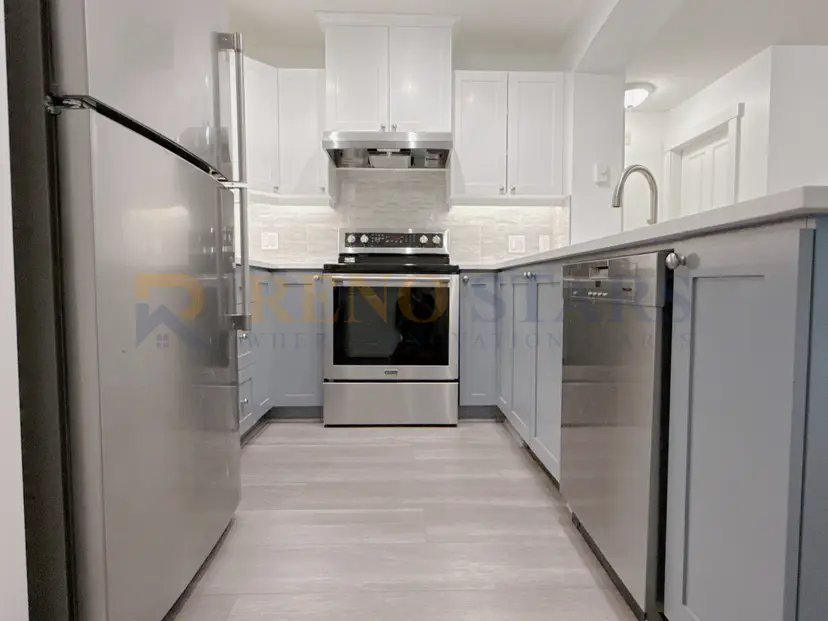
Real project context: A budget-friendly Richmond condo renovation we completed ($26,000–$28,000) included both kitchen and bathroom upgrades that increased the rental asking price by $400/month — a 17-month payback on the renovation cost.
Before Renovating: The Landlord's Renovation Rules in BC
Tenants in Place
Under BC's Residential Tenancy Act, you cannot renovate a tenanted unit without the tenant's cooperation — and you cannot evict a tenant simply to renovate (this is called "renoviction" and is restricted):
- Cosmetic work (paint, flooring not requiring vacant unit): Requires 24-hour notice
- Major renovation (requires tenant to vacate): Requires a valid building permit AND you must offer the tenant right of first refusal to return at the same rent
- Demolition: Different rules apply — consult a tenancy lawyer
Practical approach: If your tenant's lease is expiring, plan the renovation for the turnover period. This is the cleanest path and avoids any tenancy disputes.
The Rental Market Exception
In Vancouver, many landlords do "turnover renovations" — the period between tenants, typically 2–4 weeks. Budget for:
- Cleaning + painting: $2,000–$5,000
- Flooring repair/replacement: $3,000–$8,000
- Fixture updates: $1,000–$3,000
- Total turnover reno: $6,000–$16,000
- Rent increase: $200–$500/month
- Payback: 1–4 years
This is the most common renovation cycle for Vancouver landlords and offers excellent risk-adjusted returns.
The Numbers: Turnover Renovation ROI Calculator
Example property: 2BR apartment in Burnaby, currently renting at $2,800/month
Renovation scope (turnover):
- New LVP flooring: $5,500
- Fresh paint + ceiling: $2,800
- New bathroom vanity + fixtures: $3,200
- New kitchen faucet + backsplash tile: $1,800
- Lighting package: $1,200
- Total: $14,500
Rent increase achieved: $350/month (new asking price: $3,150)
Payback calculation:
- Annual rent increase: $350 × 12 = $4,200
- Payback period: $14,500 ÷ $4,200 = 3.45 years
- After 5 years: Net gain = ($350 × 60 months) – $14,500 = $6,500 net
- After 10 years: Net gain = $27,500 net
Plus equity: A well-maintained, recently renovated rental unit appraises 8–15% higher than an equivalent unrenovated unit. On a $900,000 property, that's $72,000–$135,000 in additional equity.
Which Renovations to Skip in Rental Properties
Not every renovation makes sense in a rental context:
Skip:
- High-end custom cabinetry (tenants won't pay proportionally more)
- Imported marble tile (maintenance nightmare, doesn't justify rent premium)
- Smart home systems without property management protocols (they break, you fix them)
- Luxury fixtures in budget rentals (they get damaged and cost more to replace)
Focus on:
- Durability over aesthetics (LVP flooring > hardwood; porcelain tile > stone)
- Easy-clean surfaces (matte finishes, smooth grout lines)
- Neutral colors (white/grey/beige — broad tenant appeal, easy touch-up)
- Commercial-grade hardware (hinges, drawer slides — they last longer under rental use)
Financing Your Rental Property Renovation
Several tools are available specifically for landlords:
1. HELOC on the rental property: If your property has equity, a HELOC gives you renovation capital at prime + 0.5–1.5%. Interest is tax-deductible (consult your accountant).
2. BC Secondary Suite Incentive Program: Up to $40,000 forgivable loan for adding a legal secondary suite. Available to homeowners who will live in the property.
3. CMHC MLI Select: For multi-unit properties (4+ units), favourable mortgage insurance rates for renovating to improve affordability or sustainability.
4. Capital cost allowance (CCA): Renovation costs on rental properties can be depreciated for tax purposes. A rental property renovation advisor can structure the work to maximize CCA claims.
Getting Started: Questions to Answer Before You Renovate
- Is the unit currently tenanted? If yes, plan around the lease end date.
- What's your renovation budget? Match scope to budget — partial renovations often don't generate proportional rent increases.
- What are comparable units renting for in your neighborhood? Know your ceiling — renovating a unit in a $2,000/month building won't make it rent for $3,500.
- Do you have permits for an existing suite? An unpermitted suite is a liability in BC — legalize it before selling or claiming rental income.
- What's your hold period? Short-hold investors prioritize quick ROI (turnover renos). Long-hold investors can justify suite conversions.
Related Reading
- Basement Suite Renovation Cost Vancouver 2026
- How to Finance Your Vancouver Renovation
- Kitchen Renovation Cost Vancouver 2026
- Bathroom Renovation Cost Vancouver 2026
Reno Stars has renovated rental units across Burnaby, Richmond, Vancouver, and Coquitlam. If you're calculating the ROI on a rental renovation, contact us for a detailed scope and estimate.
When renovation projects add new appliances, EV charging stations, or smart home systems, a critical load panel upgrade is often needed to safely handle the increased electrical load.
For homeowners planning long-term or accommodating family members with mobility needs, accessible bathroom renovations — including grab bars, curbless showers, and slip-resistant flooring — are a smart addition to any major renovation project.
If your Metro Vancouver home was built before 1995, it may have poly-B pipes. Our poly-B pipe replacement service addresses this common issue before it leads to costly water damage — something worth considering during any major renovation.
If you live in a strata property (condo or townhouse), review BC's strata renovation rules before starting work — many projects require strata council approval and must follow specific noise, hour, and contractor requirements.
Frequently Asked Questions
What renovations give the best ROI for rental properties in Vancouver?
For Metro Vancouver rental properties, highest-ROI renovations (measured as increased monthly rent per dollar invested): (1) Kitchen appliance upgrade — $3,000–$6,000 investment, can increase rent $100–$200/month ($1,200–$2,400/year). 2–3 year payback; (2) Flooring replacement (carpet to LVP) — $4,000–$8,000, increases marketability + rent $50–$150/month; (3) Bathroom fixture update (vanity, toilet, light) — $3,000–$6,000, $75–$150/month rent increase; (4) Secondary suite creation — $70,000–$120,000, adds $2,000–$2,800/month rental income. 3–5 year cash payback + capital value uplift. Avoid: cosmetic renovations that don't increase rents (painting only, minor landscaping) or luxury upgrades that don't match the rental market tier.
Are rental property renovation costs tax deductible in Canada?
Yes — with important distinctions. Repairs and maintenance (keeping the property in the same condition) are fully deductible as current expenses in the year incurred. Capital improvements (upgrading or extending the property's useful life) are deducted over time via Capital Cost Allowance (CCA — depreciation). In practice: replacing carpet with LVP (betterment) = capital; fixing a broken window = repair = current deduction. The CRA's distinction: if you're improving beyond original condition, it's capital. Consult a Vancouver accountant experienced in rental property — the line between repair and improvement is fact-specific. Reno Stars provides detailed itemized invoices that help categorize costs correctly.
Should I renovate a rental property before or between tenants in Vancouver?
Between tenants is usually the best time: no rent loss from displacement, no disruption to tenants (legal issues around construction during tenancy in BC), and faster work completion without scheduling around occupants. If the renovation is cosmetic (paint, flooring), the turnaround should take 2–3 weeks. If extensive (kitchen/bath), budget 4–8 weeks between tenancies. Under BC's Residential Tenancy Act, ending a tenancy for renovation requires a specific 2-month notice process with proper Form RTB-32 filing — Reno Stars advises clients on the legal process for tenancy end-for-renovation scenarios.
What is the 2026 rental market like for renovated vs. unrenovated properties in Vancouver?
Renovated rental properties in Metro Vancouver command a 15–30% rental premium over unrenovated comparable units in 2026. A renovated 2-bedroom apartment in Burnaby: $2,600–$3,200/month. Unrenovated comparable: $2,100–$2,500/month. The gap is widening as tenant expectations rise and rental stock ages. Renovated units also experience lower vacancy rates (days-on-market 50–70% shorter) and attract longer-tenancy, lower-maintenance tenants. For investors: renovating before listing is almost always justified in Metro Vancouver's tight rental market — the premium recovered in 3–6 months of higher rent.
How do I handle tenant displacement for a renovation in BC?
Under BC's Residential Tenancy Act, landlords must provide 4 months' written notice to end a tenancy for major renovations requiring a building permit. You must: use the official Notice to End Tenancy for Demolition, Renovation or Conversion (RTB-32); pay one month's rent in compensation to the tenant; have all permits in hand before issuing notice (or file an application with RTB); and offer the tenant first right of refusal to return at the same rent after renovation. Non-compliance risks a $5,000+ penalty from the RTB. Reno Stars does not provide legal advice but strongly recommends clients consult a BC landlord-tenant specialist before issuing any renovation notices to current tenants.
See our verified five-star reviews from Metro Vancouver homeowners.
About Reno Stars — Vancouver-based renovation company serving Metro Vancouver since 2019.
View our renovation project portfolio →
What renovation budget should I plan for a Vancouver rental property in 2026?
Vancouver rental property renovation budgets: Between-tenant cosmetic refresh (paint, flooring, fixtures): $15,000–$25,000 for a 1-bedroom suite. Full renovation between tenants (kitchen, bathroom, flooring): $25,000–$50,000. Legal suite conversion (basement): $75,000–$120,000 for a full legal secondary suite that qualifies for CMHC MLI Select financing. At $2,600–$3,200/month (current 1-bedroom Vancouver rates), a $25,000 cosmetic renovation pays back in 8–10 months of incremental rent vs leaving the unit in pre-renovation condition. The ROI is highest when timed between tenants to eliminate rental income disruption.
Also see: renovate vs move in Vancouver | what to fix before listing | basement renovation cost Vancouver 2026 | Renovation Financing Options | Pre-Sale Renovation Advice & Realtor Services | Whole-House Renovation Vancouver | Heat Pump Installation Vancouver | Basement Renovation Vancouver | BC Renovation Permits Guide | Vancouver Renovation Cost Guide 2026 | How to Choose a Contractor | Renovation Timeline Guide
See Also — Renovation Cost Guides
- Whole House Renovation Cost Vancouver — average $50K–$300K+
- Cabinet Refinishing Cost Vancouver — from $4K for refinishing
Reno Stars
Professional renovation company serving Metro Vancouver with 20+ years of experience, $5M CGL insurance, WCB coverage, and up to 3-year warranty.