
Aging in Place Renovation in Vancouver: What It Costs and What Actually Helps (2026)
Aging-in-place bathroom and kitchen renovations in Vancouver range from $8,000 for targeted safety upgrades to $80,000+ for full wheelchair-accessible conversions. See real 2026 prices and what makes the difference.
Vancouver homeowners planning to stay in their homes through retirement face a common question: how much does an aging-in-place renovation actually cost, and which upgrades genuinely reduce fall risk versus ones that look good but do little? Reno Stars has completed accessible bathroom and kitchen renovations across Metro Vancouver including Burnaby, Richmond, North Vancouver and Delta, and this guide shares the real 2026 pricing from those projects.
How Much Does an Aging-in-Place Renovation Cost in Vancouver?
The cost of an aging-in-place renovation in Vancouver in 2026 spans a wide range depending on scope. Targeted safety upgrades run $8,000-$18,000. A full curbless shower conversion with widened doorways and roll-under vanity typically costs $25,000-$45,000. A complete wheelchair-accessible primary bathroom renovation reaches $40,000-$80,000 or more. The difference between each tier is not cosmetic — it is structural changes, plumbing relocation, and code compliance that drive the price.
Planning a bathroom, kitchen or whole-house renovation in Vancouver? Get a free, no-obligation quote from Reno Stars.
Which Upgrades Actually Reduce Falls?
The most dangerous room in the home for seniors is the bathroom. Wet tile floors, high bathtub walls, and tight clearances around the toilet are the three most common fall risk factors. Effective aging-in-place upgrades address exactly these three problems.
A curbless (zero-threshold) shower eliminates the 6-8 inch step that sends thousands of seniors to the ER each year in BC. Linear floor drains allow the entire bathroom floor to drain — no center bump, no ponding water, and a wheelchair can roll straight in. A comfort-height toilet at 17-19 inches instead of the standard 15 inches reduces the knee flexion needed to sit and stand, which matters for anyone with hip or knee arthritis.
Grab bars carry a surprising specification that most installers miss: they must be rated to 200 kg (450 lbs) in shear and pull-out force, mounted on 2x6 wall backing — not just drywall. Reno Stars installs blocking at every grab bar location as standard practice on aging-in-place bathroom projects, not as an add-on.
R10/R11 anti-slip tile with a wet DCOF rating of 0.42 or higher per ANSI A137.1 is required in accessible showers by BC Building Code s3.8. Standard glossy tiles that look safe when dry become dangerously slippery when wet — this is one place where appearance misleads.
Real Project: Custom Kitchen Renovation in Burnaby
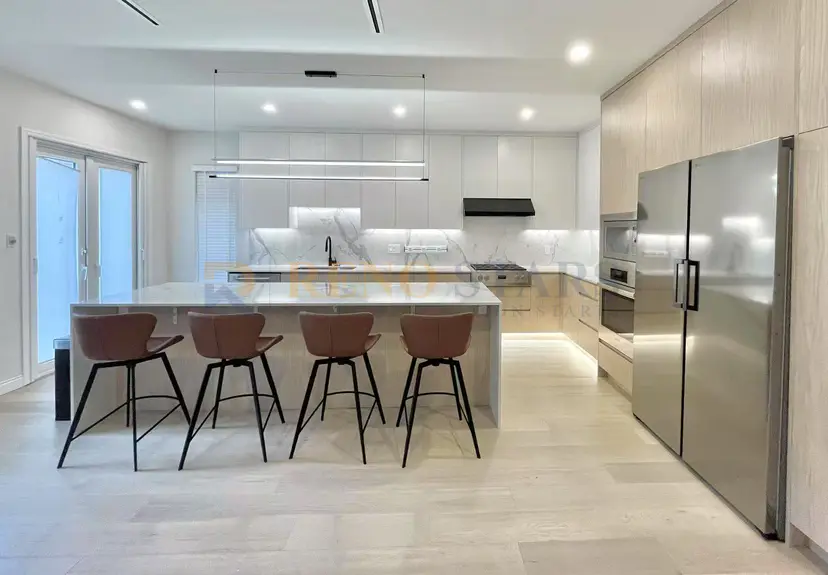
Aging in place is not only about bathrooms. The kitchen is the second most common site of senior injury at home, and it is often the first room to become inaccessible after a mobility change. One Burnaby client contacted Reno Stars after a knee replacement made their standard-height kitchen cabinets impossible to reach without a step stool.
Reno Stars completed a custom kitchen renovation in Burnaby with pull-out shelving, lowered counter sections at 34 inches (standard is 36), and a roll-under sink with insulated p-trap to prevent leg burns. Pull-out shelving alone transformed usability — every item in the cabinet is visible and reachable without reaching or kneeling. The client reported being able to prepare meals independently again within two weeks of the renovation completing.
Full kitchen renovations of this scope in Metro Vancouver typically run $40,000-$80,000 in 2026 depending on cabinet tier and whether layout changes involve plumbing or gas line relocation.
Real Project: Two-Bathroom Renovation in Burnaby
A family in Burnaby undertook a two-bathroom renovation with custom features that included a curbless shower in the primary bathroom and grab bar blocking installed throughout both bathrooms during renovation — before any mobility aid was needed. The cost premium for blocking at this stage was approximately $600 across the project. Retrofitting the same blocking after tiling would have cost $2,500 in tile demolition and reset.
This is the core principle of aging in place: the cheapest time to build accessibility in is during a planned renovation, not after an injury or diagnosis creates urgency and limits options.
Code Requirements for Accessible Renovations in Vancouver
BC Building Code s3.8 (Barrier-Free Design) sets the minimum accessibility standard for renovations in British Columbia. For a full accessible conversion, the code requires a 32-inch minimum clear door width, 60-inch turning diameter in bathrooms, and interconnected smoke and CO alarms throughout the residence.
CSA B651-23 (the 2023 accessibility standard) governs fixture heights, grab bar load ratings, and clearance dimensions for full wheelchair-accessible builds. Reno Stars designs aging-in-place bathrooms to satisfy both BC s3.8 and CSA B651-23, and coordinates with occupational therapists when one is involved in the project to ensure the layout matches the client's specific mobility profile.
Smart Home Features That Support Aging in Place
Mechanical upgrades alone do not make a home safe. Lighting and emergency response are equally important and often overlooked. Motion-activated path lighting reduces nighttime fall risk significantly — a 2024 BC injury prevention study found that 40% of senior falls at home occur in low-light conditions.
Voice-controlled lighting (Alexa or Google Home compatible) allows hands-free operation at any mobility level. Heated floors serve dual purposes: comfort and faster drying of wet floors after showering, which reduces slip risk throughout the bathroom. Emergency call buttons wired to an external light, a smart-home alert, or a monitored medical service provide a response pathway when a fall occurs and a phone is out of reach.
Apple Watch fall detection integration is a growing request in Vancouver aging-in-place projects. Reno Stars can advise on bathroom placement to ensure the watch maintains connectivity and can detect a fall event in the shower or near the toilet.
Future-Proofing: What to Build Now versus Later
| Upgrade | Cost During Reno | Cost to Retrofit Later |
|---|---|---|
| Grab bar wall backing (2x6) | $200-$400 | $2,500 (tile demo + reset) |
| Curbless shower slope | $800-$1,500 included | $4,000-$8,000 (floor rebuild) |
| Rough-in for future bidet | $150-$300 | $1,200-$2,500 (wall open) |
| Reinforced ceiling joist for ceiling lift | $400-$800 | $3,000-$6,000 |
The pattern is consistent: blocking, rough-ins, and structural prep done during a renovation cost a fraction of what they cost as standalone retrofits. This is why aging-in-place advisors recommend building these elements into any planned bathroom or kitchen renovation, even if no accessibility need exists today.
Funding for Aging-in-Place Renovations in BC
BC's Home Adaptation for Independence (HAFI) program provides up to $20,000 in reimbursement for accessibility upgrades for income-qualified low-to-moderate income seniors and people with disabilities. The grant covers items including curbless showers, grab bars, widened doorways, and ramps — exactly the work that aging-in-place renovations include.
Reno Stars provides itemized invoices, photo documentation, and pressure-test certificates that satisfy HAFI application requirements. We complete the contractor portion of the HAFI application and can recommend occupational therapists who conduct the functional needs assessment the program requires.
Other funding streams include Veterans Affairs Canada home modification benefits (for eligible veterans), the Disability Tax Credit (renovation costs may qualify as a medical expense), and the RRSP Home Buyers' Plan for first-time homebuyers with disabilities (up to $35,000 RRSP withdrawal for accessible construction).
Aging in Place Renovation FAQs
How much does an aging-in-place bathroom renovation cost in Vancouver?
Targeted safety upgrades in Vancouver — grab bars, comfort-height toilet, anti-slip coating — run $8,000-$18,000. A curbless shower conversion with widened doorway and roll-under vanity costs $25,000-$45,000. A full wheelchair-accessible primary bathroom renovation typically costs $40,000-$80,000+. Most of these costs may be partially offset by the BC HAFI grant of up to $20,000.
What is the difference between aging in place and accessible renovation?
Aging in place refers to remaining in your home as mobility changes, with modifications that support independence. An accessible or barrier-free renovation is the physical work that enables that — curbless showers, grab bars, widened doorways, and roll-under fixtures. All are governed by BC Building Code s3.8 and CSA B651-23 for full compliance.
Does Reno Stars work with occupational therapists for aging-in-place projects?
Yes. Reno Stars regularly coordinates with occupational therapists who specify clearance requirements, fixture heights, and transfer-space dimensions for their clients. Involving an OT before finalizing scope ensures the renovation matches the client's current and projected mobility needs rather than designing to a generic standard.
What is the BC HAFI grant and how do I apply?
The BC Home Adaptation for Independence (HAFI) program reimburses up to $20,000 for accessibility upgrades for income-qualified homeowners. An occupational therapist must assess functional need, and the work must be performed by a licensed contractor. Reno Stars provides all documentation required for HAFI submissions and has guided multiple clients through the process.
Is a curbless shower worth the extra cost?
For any homeowner over 50, yes. A curbless shower eliminates the most common bathroom fall mechanism (the tub wall step), works with a wheelchair or walker from day one, and typically costs $3,000-$6,000 more than a standard shower insert when built during an existing renovation. Retrofitting one after the fact costs $4,000-$8,000 and requires floor reconstruction. Building it in during a planned renovation is the lowest-cost opportunity.
Reno Stars
Professional renovation company serving Metro Vancouver with 20+ years of experience, $5M CGL insurance, WCB coverage, and up to 3-year warranty.